
anOther Nemesis, by Ai Jiang, Angela Yuriko Smith, Eugen Bacon, and Maxwell I. Gold
(Meerkat Press, 2026). 100 pp. $16.95 paperback. https://meerkatpress.com/books/another-nemesis/
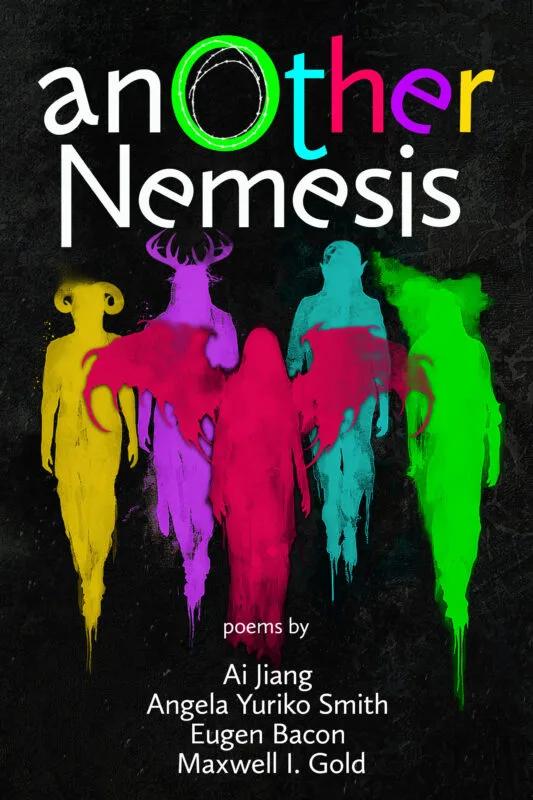
In anOther Nemesis, four poets offer their takes on broad topics, while at the same time providing insight into the thinking behind their creations. The book is divided into four sections, The Colonizers, Primal Sources, Nameless Others, and Crooked Ontologies. Each section includes three to five poems by each poet, with the collection including 55 poems in total.
The majority of poems are prose poetry, free verse, and haibun, though other forms such as acrostic also appear. Tone and imagery in a number of the poems is on the dark side, though there is also levity and satire. Each poet’s poems in the various sections are grouped together, and are introduced by a “Behind the Poems” segment including insights from the poet on the thinking behind their works.
Certain poems stood out for me. Ai Jiang’s “an unbuilt thing,” which includes the lines “an open house without visitors, or perhaps visitors / know it isn’t a place they should be treading” was one of them. “A Home You Don’t Remember How to Miss” describes
a place renamed, unnamed, renamed,
until it has forgotten what it had been
before the touch of human hands,
untrodden by human footprints,
now holding memories not its own.
“Skin and Bones” notes,
Your skin does not see its own color,
or the scars and patterns etched,
carved not by biology but by society.
It will always feel society.
Eugen Bacon’s “Relax” was powerful, as was “Unnatural Disaster”:
she sits on her broomstick
thirteen steps from the party
this is a safe country
all these walls have collapsed
Bacon’s poem “Calibration” includes the lines “worlding the merpeople insists on fundamental descaling and / tail amputation without anesthetics to ascertain if the language / of crying harbors an ideology of resistance.”
Angela Yuriko Smith’s haibun poems present different views of figures from myth and literature such as Lilith, Echo, Hermes, Anansi, and others. In many cases, the first section of the haibun provides highlights of the character’s mythological or literary background, while the next section re-imagines them in modern times, often with a social media or technological slant. For example, in the poem “Thoth,” the modern version “favors vintage spectacles over feathers” and “codes in silence, scripts sacred algorithms, and leaves breadcrumbs of ancient insight buried in open-source files.”
In “Orpheus,” the title character “plays not for gods, nor to conjure the dead, but he busks unseen on street corners, notes drifting through subway tunnels and alleyways, a lullaby for the lost and lonely.” “Odin” describes a Norse god who “watches from darkened café corners, one-eyed observer in gray, scribbling verses into Moleskine journals. His wisdom now grumbled advice shared over watered beers and in anonymous forums, blogs encrypted with mundane metaphors.”
Walls, darkness, apocalyptic settings, and othering are frequent motifs in Maxwell I. Gold’s poems, though there is also hope for a time when walls and closets might be a thing of the past.
Some of Gold’s poems explore what humanity has done to the planet. “A Conversation with Mass Extinction” begins “Seven conversations. And conversations were short.” The poem concludes, “conversations were always short, / especially with humans.” “What Else Were We to Do” explores humanity’s reluctance or inability to act despite the increasing severity of the issues arising from our mistreatment of the planet.
In the “Behind the Poems” commentary for his “Crooked Ontologies” poems, Gold writes, “Hope is not the conviction that everything will turn out to be okay, but the determination that things might make sense in the end.” Food for thought.
The idea of having different poets address the same themes was appealing, and I also found each poet’s “Behind the Poems” sections of interest. Many of the poems bear lingering over, as there is density and layering of meaning in works like Ai Jiang’s poem “English.” Humor, satire, and honesty pervade the poems in anOther Nemesis, which convey a sense of the personal while also touching on the universal. An interesting and thought-provoking collection.
—Lisa Timpf