
A Tribute to David Kopaska-Merkel
by M. Frost
This winter, I finally got around to something I’d meant to do for a while. I bought a lifetime subscription to Dreams & Nightmares, one of the longest-running markets for speculative poetry. It was D&N’s 40th anniversary year, and David and I were publishing twins, with poetry chapbooks released back-to-back by Island of Wak-Wak.
Plus my spidey senses were tingling. (They do that sometimes; I’ve learned to obey.) I requested the subscription, sent the ridiculously low payment ($39).
He emailed back. “Are you going to want all available back issues?”
“Yes, please!”
What followed was extraordinary—a thread of over 60 emails we exchanged over a few months, during which he would batch a group of PDFs every few days to a week, and I would marvel at what unfolded. The file names were compact: DN1 (1986) through DN132 (2026), but the contents were a window into the evolution of speculative poetry itself.
What you need to understand is that I came to speculative poetry around 2005 (after David’s accident that left him using a wheelchair) and never met him in person. I knew him first by reputation, then had the joy of my first D&N poetry acceptance in 2006: “The Women of Myth.” When I found out he was a geologist—not my science, but a fellow scientist, yay—I felt like I had found community. We bonded over a love of fossils. He admitted. “I have a big chunk of Mississippian coral by my front door.”
However, when I went back to school in 2007, I struggled to stay engaged as one more degree turned into yet another. “Ariadne’s Thread” in D&N 92 (2012) was one of my last publications before I went completely dark in terms of publishing poetry, hijacked by the life of a newly minted academic. When I reached out in 2025, David wrote back. “I had wondered what happened to you.”
I had wondered what happened to him too, and to speculative poetics in the decade I was away. I dug into the fossil record of D&N:
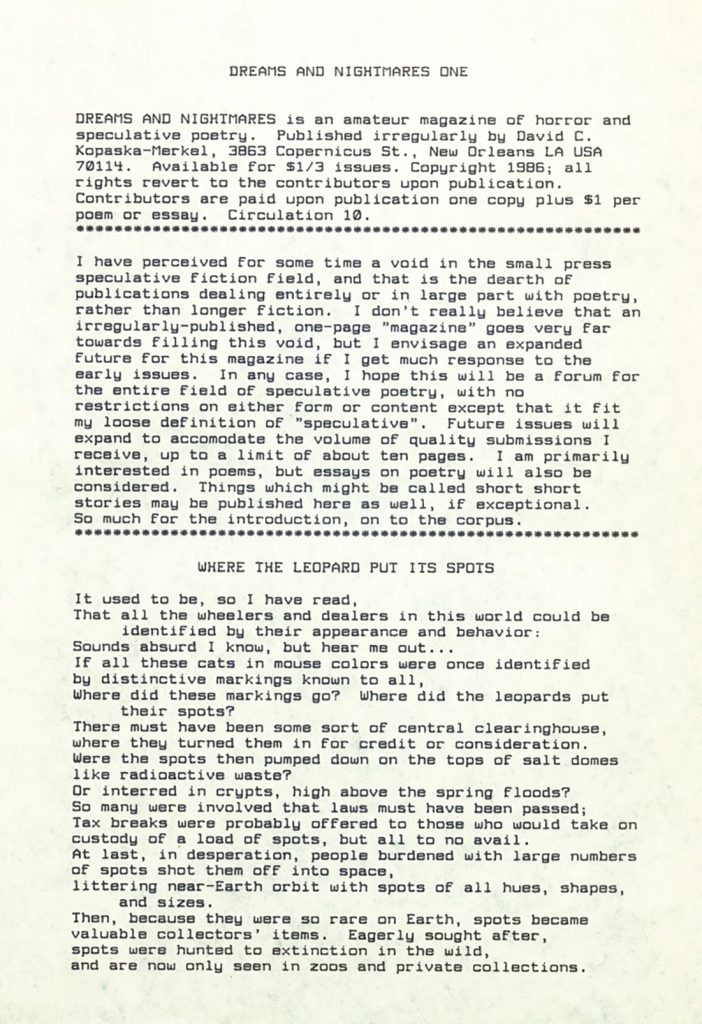
DN1-10. “A few are lost forever.” David apologized.
The last line of the poem in the first issue referenced a “private collection” (of leopard spots)—echo through time to a poem of mine he’d just published, “Visit to a Private Collection of Parietal Art.” It seemed both a happy and creepy coincidence, so I didn’t mention it.
Instead, I offered. “I especially love the evolution where you add a note about what struck you in the poem.”
He countered. “I’m afraid I quit doing that years ago” thinking that the poems “stood on their own.”
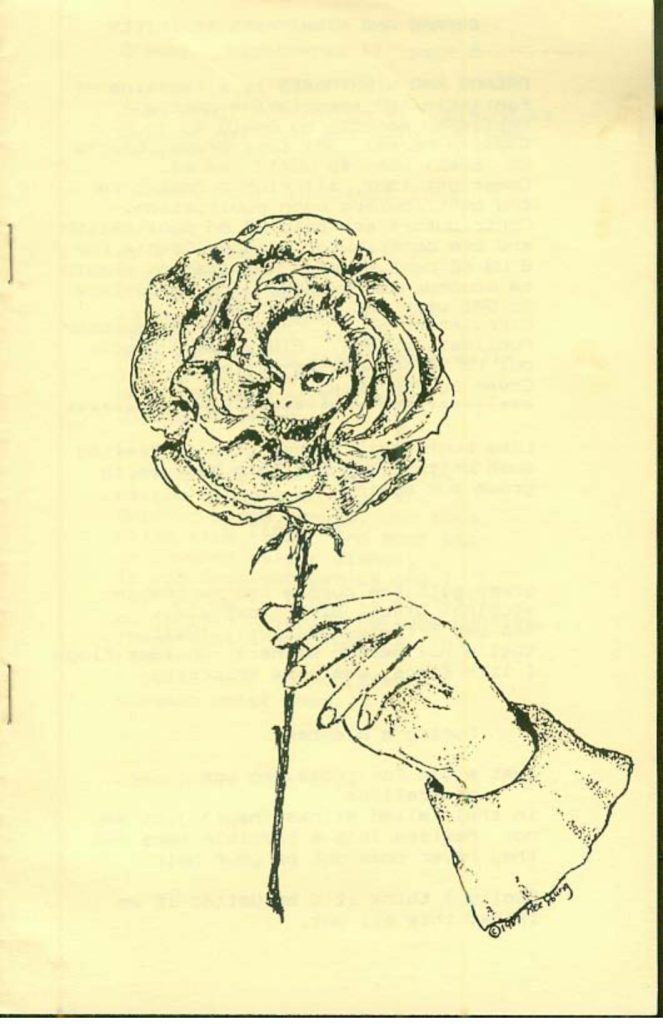
DN11-19 struck me. “The first ones with cover art, and is that text mimeograph? I can almost smell the VOCS…”
I was wrong, as David explained. “The very earliest issues were done on the dot matrix printer. Later ones were photocopied. I never used or had a mimeograph machine.”
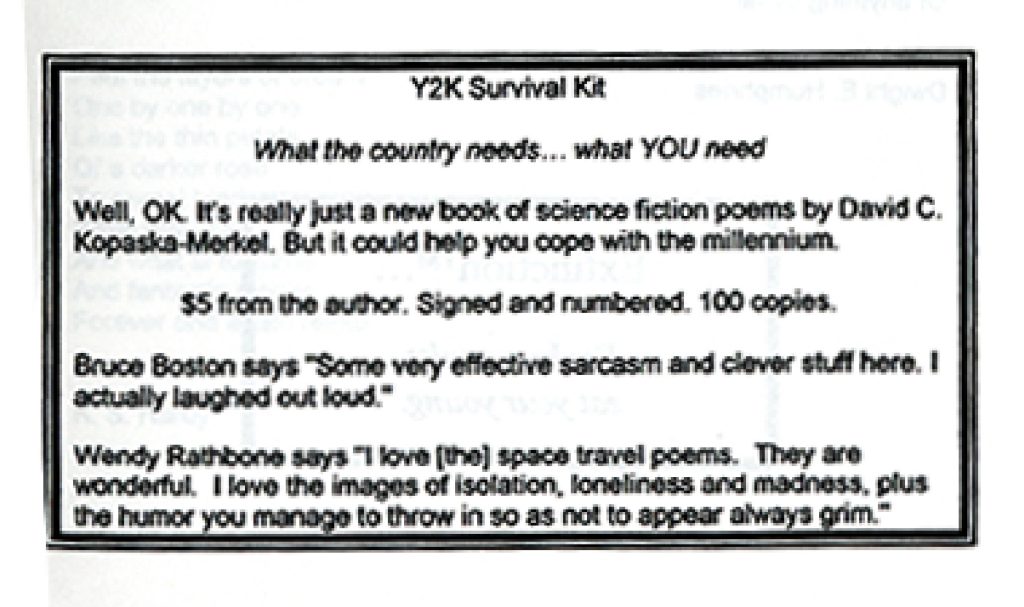
DN 53 had an ad. “I got a chuckle out of the Y2K survival kit. So many of your poems are timeless that it was fun to see something so anchored in that moment.”
He didn’t reply to that one.
DN 72-72. I was enthralled by the tables of contents. “More and more names I recognize—fun seeing the early work I didn’t know, and exciting to get closer to my entry point to spec poetry!”
He agreed. “I have noticed the same thing. The people who contributed in the early years have died or dropped out, and new people have either started writing or heard about the magazine and submitted to it for the first time.”
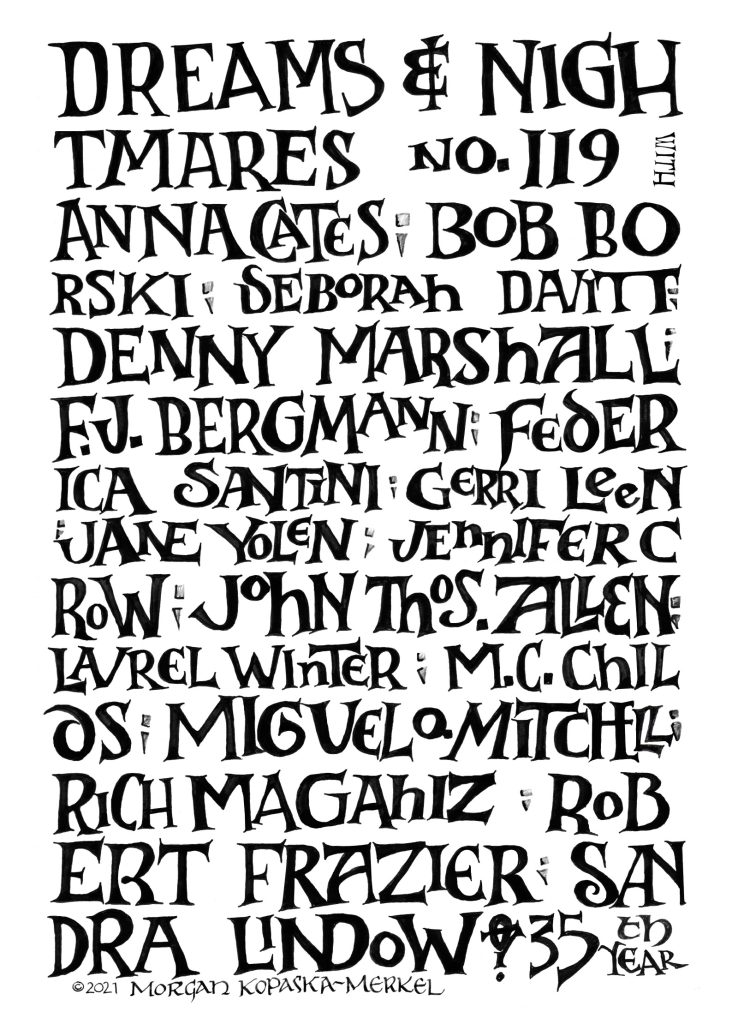
DN119 blew me away. “Tell Morgan [Kopaska-Merkel] the cover is super cool!”
“Morgan was happy that you liked her cover.” David reported. “She’s been into calligraphy since she was about eight.”
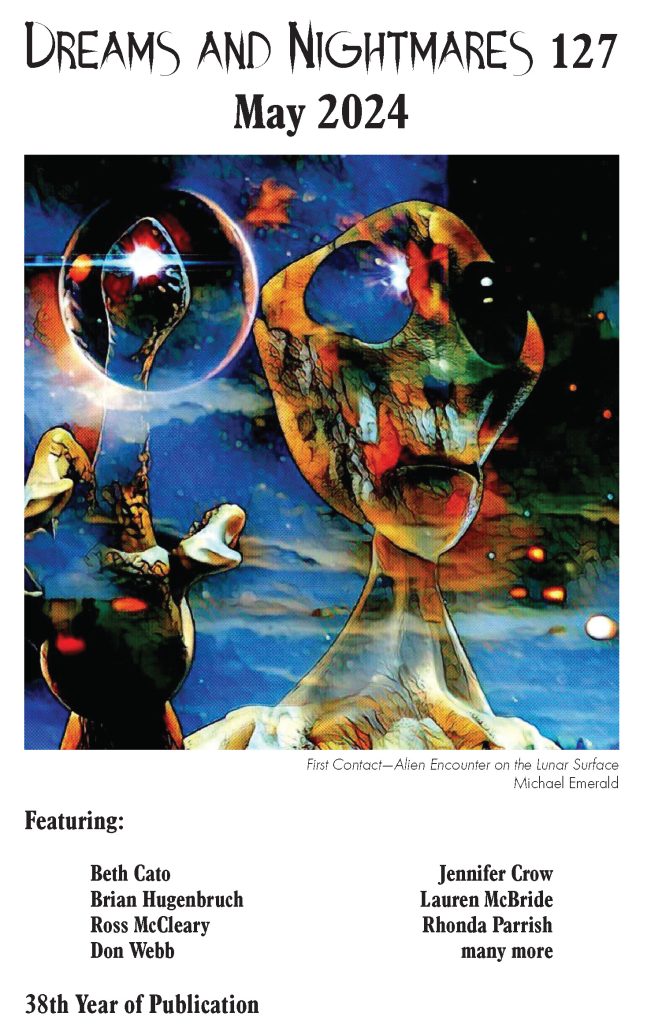
DN127 was transformative. “The move to the full-color covers is striking!”
David replied. “I had wanted to do it for a while, and then I just decided to go ahead. It wasn’t all that much more expensive.”
I found my private collection poem in the last issue he sent me, but the real gift was the (nearly) complete D&N catalogue. “This is a window into history, thank you so much for sharing it all. I’m really enjoying the time machine.”
David wrote back. “I have to admit I never thought of myself as contributing to history, but I guess in a way I have.”

The creative work of M. Frost appears in Star*Line, SpecPoVerse, Strange Horizons, Plott Hound, Dreams & Nightmares and many others, with poetry chapbooks Cow Poetry (Finishing Line Press, 2006), Constellation (CreateSpace, 2013), The Women of Myth (Island of Wak-Wak, 2025), and The March (The Arcanist, 2026). Explore more at mfrostwords.comand follow @mfrostwords.bsky.social.