
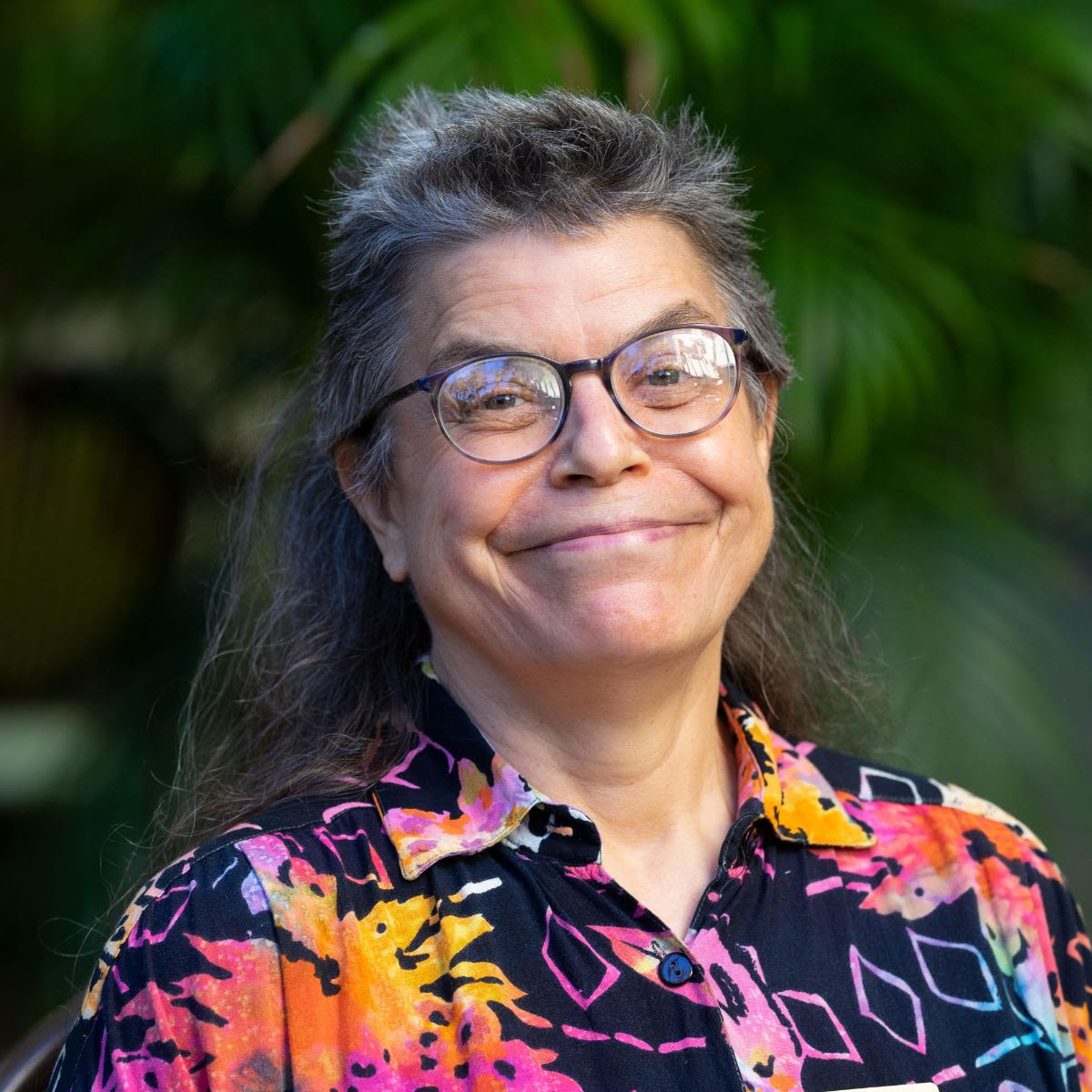
Since publishing her first poem as a teenager called "The Unicorns of Mars", F.J. Bergmann has been a leading poet in the field of speculative poetry. In 2024, she has been named a Grandmaster by SFPA and winner of the President's Service Award. While still recent, I wanted to take the chance to interview her and get her thoughts on winning the award, her writing, and other topics in the realm of science fiction and fantasy.
The SFPA Grand Master Award recognizes the contributions in poetry that a person has made in their lifetime. Their superior skill and a body of work are testaments to talent and a resource for inspiring other poets and furthering knowledge of the genre.
The President’s Lifetime Service Award is given to an individual who has furthered the knowledge, appreciation, and acceptance of the speculative poetry genre, and who has served the SFPA in a significant volunteer capacity.
Interview
How did it feel to be voted a Grandmaster and win the President’s Service Award? That was really a surprise. I think Debbie Kolodji, who won the President’s Service Award last year and really deserved it, should’ve received the Grandmaster award this year, but that’s the membership vote.
But, I felt really honored. I’ve been with SFPA for quite a while, since 2007, and I’ve done a lot of the behind-the-scenes work. I’ve done the layout for all the publications since 2011 or 2012, and I was webmaster from 2010 onward until last year. I was briefly vice president, and that’s my only officer stint. I’ve edited Star*Line twice, once for five years and then a couple of years between editors. I’ve also edited one issue of Eye to the Telescope.
What made you decide to join SFPA? I really liked science fiction. There was a long gap between writing poetry in high school and college and then not writing at all for over twenty years. I continued to read science fiction and fantasy voraciously during that entire period. When I finally began writing poetry again in the late 1990s, it was normal for me to include science fiction in the poetry. Then I became aware that there were publications and an organization that specialized in this field, and then I became interested.
What is your background in writing speculative poetry? Did you start in the speculative genre? Actually, yes. The first published poem I had which was published while I was in high school was titled “The Unicorns of Mars”, which I think says it all.
What did you do in the space between when you wrote poetry in high school and college and when you began writing poetry again twenty years later? Well, I read voraciously. We were poor, and we moved around a lot. It kept me grounded as well as serving as a great escape, of course, which was the point.
I was mostly working with horses during that time. That’s something that definitely keeps you connected to the fantasy world and the real world, and much more of that idea of working with alien beings, and working with consciousness that is not human. I did a lot of training and competition. Novices have a lot of trouble getting used to horses because they’re not like dogs and cats. They’re not predators, they’re prey animals, so they have a completely different vocabulary of reactions. When anything happens that might be threatening, they’ll either leap around like a maniac, run really fast, or kick the shit out of it.
How would you characterize the writing style you use in your poetry? It tends to be very prosaic, but I have a repertoire of styles. We see that across what I’m reading, from tough guy military fiction to high-flown, verbose high fantasy. I tend to dislike poetry that imitates 18th or 19th century poetry. I’m open to anything else, and to trying anything else.
So you like poetry that takes new slants/angles on things? I did have a lot of STEM classes in college. I continue to keep up with current developments in science. That tends to inform some of my poetry. I am by no means a scientist, but I am familiar with its vocabulary and concepts. When new and interesting things come along, I glom on to them.
A lot of your poems draw on folklore, mythology, and science. How do you find ways to put all those together in your poetry? I think making unusual associations is part and parcel of being a poet. I think you have to be able to do that. All good poems have a surface meaning and a subtext, sometimes several subtexts. Sometimes the subtext, the secondary meaning or the tertiary meaning depending on what's in the poem, can be something that refers to a completely different field.
Subjects and topics like gender, sexuality, oppression, and racial commentary find their way into your poetry as well. What makes topics like these so prevalent in your writing? What makes speculative poetry a good genre for exploring these topics? The risk of writing in the real world is that when you want to say something about oppression, for instance, or when you want to make some kind of ethical statement, it can be difficult to draw on [experiences other than] one’s own experience. That’s always going to be limited with regard to gender, ethnicity, and history, etc. The advantage of science fiction and fantasy is that you can create a situation that is sufficiently different from the real world that anyone can identify with it or that anyone can understand what’s going on. They may not even realize what they’re being given to look at. To put real-world questions into something that is not the real world.
I definitely like that Star*Line is a publication that exists, because it’s a platform built to serve this niche genre of writing. I think many science fiction and fantasy poetry writers don’t realize just how receptive mainstream journals are to speculative poetry. This was true even when I first began writing poetry. One of the early poems I had accepted, “Moonlighting,” in Southern Poetry Review, was heavily SF with overtones of fantasy, and they’ve recently requested it for a retrospective anthology.
We’ve talked about writing speculative poetry as something where someone can learn social change, you can take different ideas and put them altogether. What about poems that you write mostly for the enjoyment of it? I am a big fan of poetry written mostly for fun. There are little poems that don’t do much but amuse. For instance, this haiku, which appeared in failed haiku: “full-moon stroll / tugging against the leash / his werewolf wife.” There’s no agenda, it’s just amusing.
Supernatural horror definitely comes under the speculative umbrella. I’ve written a surprising number of poems that could be categorized as horror. I’m wanting to put together a full-length collection, and have enough material for three or four books.
Where do you see the speculative poetry genre heading? Science fiction and fantasy have become so much more mainstream, that I think many more people are interested and open to reading it. We’re also getting a lot more members in SFPA. The organization has grown a lot in the years since I have joined. When I joined there were no Elgin Awards, for instance. Eye to the Telescope came to be after I became a member.
As the organization becomes more stable financially, and now that we’re a nonprofit, I expect we’ll be able to offer more and more. We’ve increased payment rates to poets, and I hope that will keep happening. I am definitely for paying for poetry. I think it devalues poetry to pay-to-submit, especially and then not to get paid for your work.
Last question. If you could time travel to any moment in the past or future, where would you go and why? It would definitely be the future. Of course, there are definitely many unanswered questions about the past, but all the questions about the future are unanswered. Some of my poems about aliens deal with this. I have a feeling that when aliens meet us, if they haven’t already, we may not have any ability to recognize what they are. They’re not going to be gray or green humanoid bipeds, that’s for sure.
Bio: F. J. Bergmann is the poetry editor of Mobius: The Journal of Social Change (mobiusmagazine.com), past editor of Star*Line, the journal of the Science Fiction & Fantasy Poetry Association (sfpoetry.com), managing editor of MadHat Press (madhat-press.com), poetry editor for Weird House Press (weirdhousepress.com), and freelances as a copy editor and book designer. She lives in Wisconsin with a husband, intermittent daughters, cats and a horse, and imagines tragedies on or near exoplanets. Her writing awards include SFPA Rhysling Awards for both long and short poems and SFPA Elgin Awards for two chapbooks: Out of the Black Forest (Centennial Press, 2012), a collection of conflated fairy tales, and A Catalogue of the Further Suns, first-contact reports from interstellar expeditions, winner of the 2017 Gold Line Press manuscript competition. She was a Writers of the Future winner. Venues where her poems have appeared include Asimov’s SF, Missouri Review, Polu Texni, Spectral Realms and Vastarien; her speculative fiction has been published in Abyss & Apex, Little Blue Marble (CA), Pulp Literature (CA), Soft Cartel, WriteAhead/The Future Looms (UK), and elsewhere. She has competed at National Poetry Slam with the Madison Urban Spoken Word slam team. While lacking academic literary qualifications, she is kind to those so encumbered. In a past life, she worked with horses. She thinks imagination can compensate for anything.