
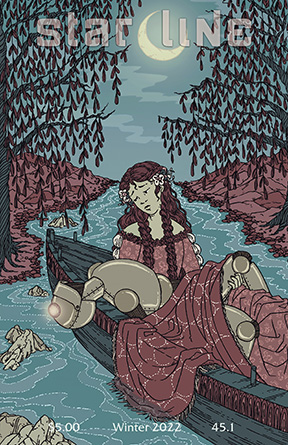
Cover: Down the River © Dante Luiz
Editor: Jean-Paul L. Garnier
Layout: F. J. Bergmann
Production Manager: F. J. Bergmann
Mailing: Andrew Gilstrap
Buy this issue of Star*Line in print for $5.00 plus $2 U.S./$3 international shipping, or as a PDF for $2.50.
See our subscription page for details. Better yet, become a member of SFPA and never miss an issue!
Menu
Online Issue Contents
Wyrms & Wormholes: Power to the Poets!
Lately I’ve been lucky enough to have good news arrive, and the occasional dream come true. As is often the case the good news arrives alongside strife, hardship, and much sadness amongst many of those I care about, and those I have not yet had the pleasure to meet. Life is filled with these types of dualities, and while these juxtapositions can often feel cruel, they are also the essence of the dynamics of life. Poetry is one of those artforms that excels at expressing these dualities, and I thank all you speculative poets of the world for the opportunity to share your visions, your joys, and your pains. Personally, one can use poetry as a method of healing, but on a grander scale we are sharing stories of empathy with one another. These stories combine to form our story, on a greater cosmological scale, the ever-forming mythos of our people. Ever since the first emotion was sung, we have shared our feelings, dreams, hopes, and despairs in this way. Each and every one of your stories is relevant, important, and a piece of the history of our species. May they grow into the dreams and realities of those yet born.
The humanities do make a difference! Think of all the books that have changed the course of history. We don’t necessarily know what effect our work may have as we create it, but each of us has this potential, and words are that important. Words are that powerful, so choose wisely. Power to the poets! While we may work in isolation, we’re in this together. A better world begins with the vision of a better world, and who better to envision and dream these possibilities than an international collective of poets! Power to the poets!
—Jean-Paul L. Garnier, Star*Line Editor
Editor's Choice Poems
"The Fading of Yellow" by Kim Whysall-Hammond
Studies show that yellow is receding
there is less and less in autumn leaves
when grasses die back in dry heat
they go straight to brown.
Wicker baskets are darkening
while daffodils are bleaching to white.
Children no longer paint the Sun as yellow
but rather pink.
Scientists calculate that natural yellows
will be used up by the year 2025.
It is possible to imagine living
in a world without yellow
but subtle degradations are now
observed in the levels of blue.
By the middle of this century
each day will play out under
the primeval black of space
and all stars will be visible.
Large bodies of water already appear very green.
Glaciers and icebergs are currently shadowed in blue
if they no longer are, will they be so bright
that they cannot be seen with the naked eye?
We need not worry
there will be no ice soon.
"Utopian Cadenza," by Mariel Herbert
We skipped work to contemplate chaos theory. Nthing clozzzr 2godz thn dataa ntree, you vocalize with 99.7% confidence. You spit sparks; sizzle too close to us at the mechbar for Class 2 workers, regurgitate faux Zen advice unasked—as if we haven’t heard it before from every other buzzing Propaganda Machine(R). Our NextGen auricles siphon pizzicato chirps from your malfunctioning, smoke-detector voxbox—even white noise (that perpetual blizzard in a Dyson sphere). Bootleg AudMods filter out synthesized tinnitus from musica universalis. We skipped work to restore our demoralized archives from a zero-sum haze. Remember those who made music before, who filled our asthmatic skies so fast, so dazzling? Yes, those anomalous artists. Now our records spin themselves into extinction like carbonized Jazz men: their syncopated hearts fueled by overzealous suns.
"We Smoke Pollution," by Ai Jiang
We smoke pollution. We inhale smog through
our lungs, exhale oxygen through our pores.
They engineered us, humans, to consume
pollution rather than feed its hunger with our
waste, our greed, our materialism, our capitalism.
Our skin turns grey, grey, and greyer still,
but the earth becomes greener, more vibrant,
fertile once more. Then, we shed our skins and
watch as it turns to soil, feeding the earth and
its beings: the budding young, the withering
leaves and petals, the brittle and entrenched roots.
We pour our shades and our browns and our
whites and our blacks and our yellows into
the ground—a swirl of liquid community
coming together with the greens to save us
so we may also save them. Together in an
industry of cultures rather than markets, we
will restore Mother’s colours we had dulled.
With our skins and our limbs and our minds,
we replace plastic with paper, fossil fuel
with electricity and wind and the sun. We
whisper to one another the natural disasters,
the broken homes, the soot in lungs. And we
reach out to the people of nature, the people
who always knew what earth needed, those who
understood how to communicate with something
we hid from in cities. They teach us the ways
of the land, how to become one with nature,
how we have always been and always will be one
with the land we call home, the trees around us,
the animals we’ve shunned, domesticated, hunted.
To reclaim the connection we severed will be a long
journey, but Mother has always been waiting. And
she will continue to wait until each of her children,
man and beast and greenery, walk towards her once
more, hand in hand, with clear water flowing from
their bodies, healthy roots growing from their heads.
Then we can say, Mother, we succeeded.
"Harold and the Blood-Red Crayon," by Jennifer Crow
This tale has no happy ending, no return
to safe harbor and warm bed. Harold picked
the wrong crayon, color of gore, of living tissue
damaged and torn, and he drew nightmares
on the skin of the world until the point
of the crayon broke and the jagged edges
wore down, an old mountain
in miniature, a story told too often
as the corners of the book foxed away
to nothing. Now Harold whispers to half-asleep
children, reminding them that their parents
will die, their pets will die, the world will burn
and all the pictures, even the truest, reddest kind,
will vanish in ashes. He makes a line
between heaven and earth, sketches the curve
of a moon forever crescent, stuck behind
a leafless tree where a dragon has eaten
the last apple, and leaks flames from its nostrils
as it dreams of everything’s end. Harold curls
in the scaly curve of its tail, and smiles.
"How Long Do Monsters Live?," by Christina Sng
How long do monsters live,
I often wonder
Watching them destroy
Countless lives each day,
In constant fear for my own
And those I love.
My muscles tense up
Whenever they draw near,
Pretending to be human,
Turning on the charm,
Thinking we are fooled,
When they are the worst
Of all abominations:
Without empathy,
Without compassion
Or remorse,
The ones who murder
Without compunction
Like this one
My grandmother trapped
Over half a century ago,
Curled up in a steel cage
Still alive, staring at me
With familiar eyes,
Gleaming with hatred
For his own granddaughter.
We should have ended him
Decades ago
But we are not killers.
So we keep him locked
In this cage
To keep the world safe.
*
On my 99th birthday
After far too much cake,
I take a trip down to the shed
To see the monster again.
He looks gray and old,
Muscles atrophied and curled
But still alive,
Still with hatred in his eyes.
I have no more words for him.
I turn away and lock the shed,
Pondering
If I should set it on fire,
Relieving my descendants
Of this burden.
The alternative:
If he escapes
And once again
Tastes human flesh—
The consequences
Are unthinkable.
As I light a match, I wonder,
How long do monsters live?
Should this be
My grandchildren’s burden?
Thinking
Of their small, sweet faces,
I do not hesitate.
I set the shed on fire
And remain, unmoving
Until I see ash on his bones.
"Atom-Scattered," by Stewart C Baker
         ...
       stars
     line
   the path
  our crystal
fortress cuts through space
  at warp speed
   atom
     scat
       tered
         ...
Full Table of Contents
Departments
- Wyrms & Wormholes * Jean-Paul Garnier
- SFPA Announcements
- President’s Message * Bryan Thao Worra
- From the Small Press * Denise Dumars, Amelia Gorman, Herb Kauderer
- Stealth SF * “Creating Our Own Reality” * Denise Dumars
- Xenopoetry * Zmiana czasu (A Time Change) and Dobre samopoczucie (Good Feelings) * Tadeusz Dziewanowski, translated from the Polish by Daniel Bourne
Art
- Four-Leaf Galaxy of Funnel Universe * Denny E. Marshall
- Locked in the Picture * Moses Ojo
Poetry
- Lore * Billie Dee & Deborah P Kolodji
- Monitors * David C. Kopaska-Merkel & Kendall Evans
- [Paler than the blush] * Denise Dumars
- Habani Gomi * Sara Backer
- Earth Day * Ngo Binh Anh Khoa
- Never Was a Princess Girl * Melissa Ridley Elmes
- [Stone Age artifacts] * Ian Willey
- Medea leaves behind a letter * FJ Doucet
- The Fading of Yellow * Kim Whysall-Hammond
- Universal PMS * Eve Morton
- Utopian Cadenza * Mariel Herbert
- Terraforming In Progress * Lauren McBride
- [looking for love] * Amber Winter
- Not One of You * Nora Weston
- [one stick] * Richard Magahiz
- [making extra sure] * ayaz daryl nielsen
- [parallel universe blues] * LeRoy Gorman
- [crypt] * David C. Kopaska-Merkel
- Let’s Enjoy the Stars One Last Time * Beth Cato
- Baikonur * Richard Magahiz
- [space station love] * Amber Winter
- [Born in orbit] * DJ Tyrer
- Honors for My Lovers * Marge Simon
- The Eyes of Argus * Deborah L. Davitt
- [Going the distance] * Rose Menyon Heflin
- We Smoke Pollution * Ai Jiang
- A Change of Course * Sharon Cote
- Fallen * Jeffrey Park
- [motionless] * David C. Kopaska-Merkel
- Metapatterning for Time Travel * Robert Frazier
- Ajabu * Miguel Mitchell
- Murmuration * Mary Soon Lee
- Done Got Probed * Don Raymond
- [CCR in headphones] * Gabriel Smithwilson
- [testing the machine] * David C. Kopaska-Merkel
- The Crow’s Church * Rob Cameron
- Traveling Companions * Herb Kauderer
- book master * Herb Kauderer
- Harold and the Blood-Red Crayon * Jennifer Crow
- Goliaths * Garrett Carroll
- How Long Do Monsters Live? * Christina Sng
- Pizza Night * Sarah Cannavo
- Ratavism * DJ Tyrer
- Disproof of Concept * David C. Kopaska-Merkel
- [remote galaxy] * Greg Schwartz
- Quantum Mechanics & Auto Body Repair * Alan Ira Gordon
- Sycamore on the Outer Edge of Something * Julie Allyn Johnson
- Earth * Jonel Abellanosa
- [Green of galaxies] * Geoffrey Reiter
- Still they burn * Richard Magahiz
- The Stars Sleep Untroubled: A Villanelle Lullaby * Gerri Leen
- Behind the Monolith * Benjamin Whitney Norris
- Atom-Scattered * Stewart C Baker
- The Curves of Our Everyday Lives * Lee Hudspeth
- Finest particles’ dance * Yuliia Vereta
- When Aliens Landed on the Beach * Gerri Leen
- Fable of Beginnings (aka Big Bang Hypothesis) * Douglass Allen
- Today * Beth Cato
- Stars Thunder Down Like Rain * John C. Mannone
- Divinity * Deborah L. Davitt
- [postapocalypse] * Mark Francis
- We Need More Intrasolar Direct Flights! * Lauren McBride
- Slime, or Primordial Ooze? * Dawn Vogel
- Interview with the Flesh Eaters * Avra Margariti
- [snakeskin tote glistens] * Gary W. Davis
- Jesus! * Soren James
- Your Robotic Confidante * Nicole J. LeBoeuf
- There it Goes! * Lauren McBride
- self-advocate * Brittany Hause
- The Land of Fire and Ice * Christina Sng
- Worlds apart * Eva Papasoulioti
- [wind moans] * David C. Kopaska-Merkel
- Before and Afterimage * Jason P. Burnham
- [diamond planet] * Christina Sng
- Lullaby * Anne Carly Abad
- [millennia] * Joshua St. Claire