
For those who have read parts one, two and three of this history of speculative
poetry, part four will represent something of a departure in how it was constructed.
Where the first three parts were based on a literary analysis of several millennia of
poetry (give or take a millennium!), part four was based on interviews with five
luminaries from the contemporary speculative poetry (specpo) scene.
The prize-winning poets F. J. Bergmann, Mary Soon Lee, Beth Cato, Linda D.
Addison and David C. Kopaska-Merkel were individually provided with the same
questionnaire and asked to provide narrative-based answers. Those answers were
then analysed combined in order to create the overview of contemporary specpo
below.
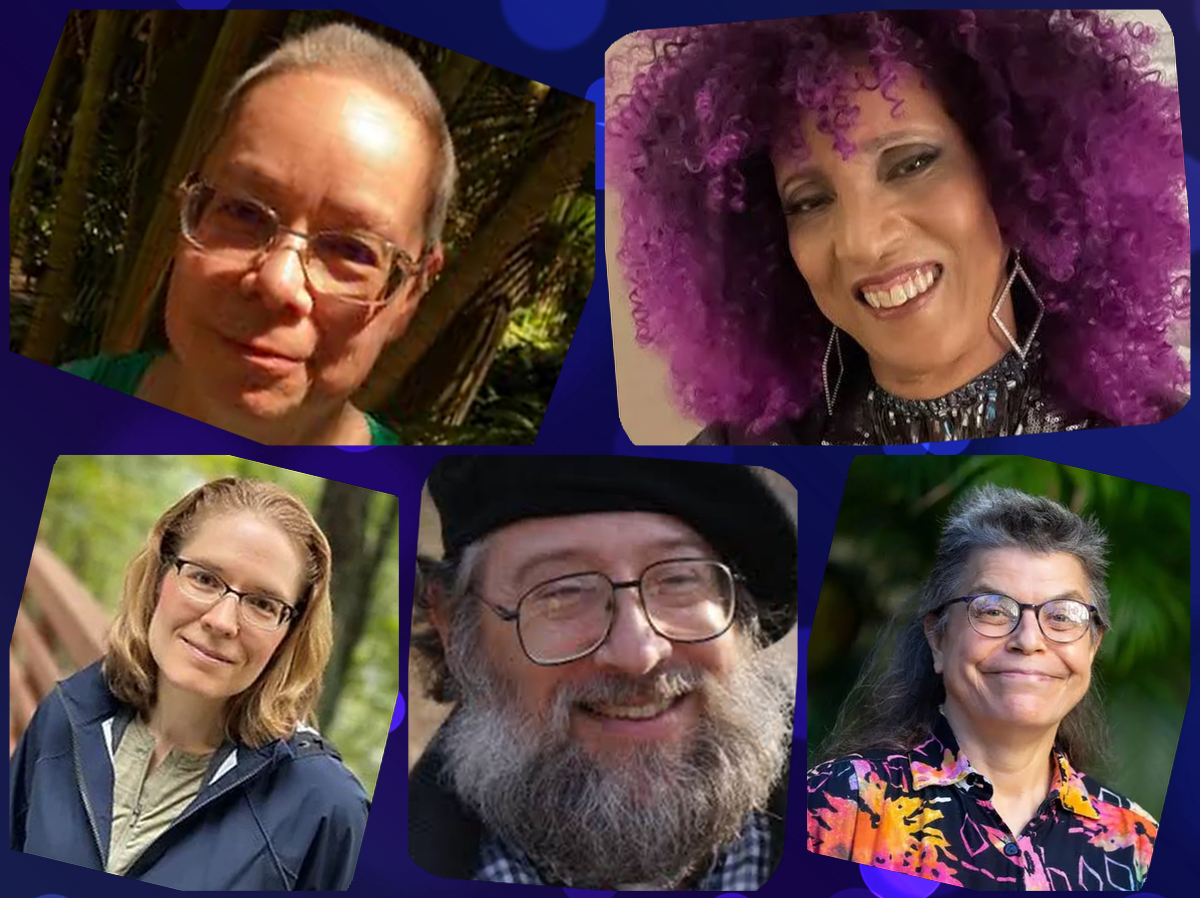
The insights of our luminaries will be invaluable to all writers, readers and
students of specpo, as they provide some authority when it comes to understanding
contemporary specpo, as well as identifying trends and anticipating the specpo of
the future. There is, then, a suitably prophetic or visionary aspect to this overview,
just as there has always been a prophetic or visionary aspect to specpo itself (see
Part One of the history for further elucidation).
Yet enough from me – let us now be illuminated and enlightened…
Question 1: In what ways do you think contemporary speculative poetry differs or is
distinct from the speculative poetry of previous eras?
Where the specpo of the past was more rhymed and metered (as per Part One),
modern specpo uses far more diverse forms and styles such as Japanese forms,
free verse, etcetera. Similarly, where poetry once had a “specific” language or style,
that language is now so close to the vernacular as to be all but “indistinguishable”
from it. The increased diversification and accessibility of specpo’s language has
enabled or resulted in or from “more poetry from writers around the world, from
vastly different places and backgrounds and life experiences”, all of which has made
specpo “richer” than in the past, which has to be good news.
It seems that themes concerning the wealth gap between rich and poor,
racism, the environment and cosmological discoveries inform contemporary specpo
as much as they do/did the specpo of the past. However, perhaps a higher
proportion of specpo in the past (particularly in the pre-technological eras) was
written within the fantasy genre compared to today: accordingly, contemporary
specpo has an increased focus on new or “unforeseen” technological and scientific
developments, such as A.I. (more on A.I. later).
Question 2: Which of the following genres of speculative poetry do you think is
currently more popular, progressive, pre-eminent or dominant: sci-fi, fantasy, horror
or the weird?
There was agreement amongst the respondents that specpo in general is enjoying a
“tremendous resurgence” in popularity, but horror poetry in particular! As a
magazine publisher, David C. Kopaska-Merkel receives more horror poetry than any
other genre, much of it “amateurish”, signalling it is perhaps a younger audience that
is embracing this genre. There was agreement that it is the current state of the world
(geo-politically and environmentally) behind the popularity of horror’s motifs, themes,
focus and relevance. As F. J. Bergmann observed, “The present state of the planet is
driving a regrettable focus on horror in my own work.”
Naturally, sci-fi and fantasy poetry are still common and widespread, although
the weird is more niche, specialised and less often written (yet still highly valued by
the wider specpo community). There is “much more crossover” and there are more
genre-splits (e.g. solarpunk) than ever before. Also, more specpo collections (in all
genres) are being published today compared to just twenty or thirty years, and
speculative poetry is now more recognised in terms of qualification for and
membership of wider communities (e.g. SFWA and HWA), award arenas (e.g.
Nebula Awards and Bram Stoker Awards) and wider poetic categories (e.g. eco-
poetry).
Question 3: What has made your poems, collections, body of work and/or wider
contribution stand out at particular times in order to win awards and recognition, do
you think?
Fascinatingly, a majority of our luminaries stated they did not know! Sadly, it seems
there is no simple formula that we can learn to guarantee success. Mary Soon Lee
was extremely apologetic for the “less-than-useful” answer, Beth Cato admitted she
“can only guess” and David C. Kopaska-Merkel confessed “it is hard for me to look
at my own work and see where it is good and where it is not.”
For all that, two specific aspects of our luminaries’ work were mentioned on
multiple occasions, so might be considered key or defining features of successful
specpo: “accessibility” and “emotions”. Furthermore, that accessibility is described
as key to enabling readers’ “emotions” when engaging with specpo.
Beth Cato spoke of “very real grief” and “different raw emotions”, stating that
“making readers experience emotions is, truly, one of the greatest powers and
honors of being a writer”. F. J. Bergmann described accessibility as requiring
“familiar starting points” and “shared experience”, along with a sharply maintained
focus to “heighten their effects”. And Linda D. Addison described how she tries “not
to preach, but instead paint a story with my poetry that can lead the reader to
feelings or questions […] I write about humans/creatures who are victimized, but not
as victims, [finding] strength inside when there should be none […] Perhaps by
giving voice to these struggles readers are engaged with my work.”
Question 4: Is there something unique or immediately identifiable that characterises
your work, would you say?
Our luminaries were as unsure with this question as they were with the previous one.
At the same time, one was certain they could sometimes identify poets just by
reading their otherwise anonymous poetry, one understood that their poetry probably
reflected their background and views, and one had a Facebook audience that could
typify their work.
Points of distinction about their work were successfully identified,
nonetheless. The respondents actually fell into two groups when doing so: 1 the
dualistically ironic and 2 the more stative or matter-of-fact
Looking at the first group, F. J. Bergmann shares that she frequently uses
humour in her work: humour is not entirely common in specpo and so it receives
particular appreciation, especially when the poet is “silly and dark in the same
poem, which I think is rare”.
Because they took to lurking behind bookcases,
wearing velvet cloaks over their stained armor,
instead of sitting in the neat rows of folding chairs,
the word has gotten out to most bookstores
that it would not be a good idea to have me read.
Beth Cato uses a similar, dualistic contrast for increased emotional impact, “offering
hope even amid darkness”, as per the beginning of the poem “Timeless Pie”. It
starts with “she saved her money to buy/ a thirty-minute trip back in time”, when she
goes to a diner where her young grandfather is working. She eats a piece of pie
there, and then brings another forward in time, to her grandmother in hospice care.
And David C. Kopaska-Merkell also employs “a mixture of humor and horror”:
Clark the Ripper
At first it was a hobby,
A bloody fine way to spend a Friday night.
But then he got hooked:
He was cutting up all weekend,
then weekdays! Lunchtime, even on his break!
Right by the water cooler with Perry in the next room!
While on the phone with Lois!
(“Clark? What’s that sound?”)
Finally it had to end – the city was nearly deserted
and he was running out of freezer space.
Still, no one suspected
his secret identity.
However, Mary Soon Lee is sometimes more prosaic in approach, telling us, “I
think of most of my poetry as relatively straightforward/accessible. I often write
narrative poetry, but by no means always do so. I have written quite a lot of science
poetry, some of which is speculative.”
Helium, He
Begin universe.
Wait three minutes to enter.
Stay cool. Don't react.
And Linda D. Addison is equally “inspired by scientific theory or nature […] I like to
search the net for different things I’m curious about and I keep a note document for
most of my poems with links to facts”:
Exploding
light into darkness,
the Yet Known Universe
unfolds multi-dimensional
origami, bits & pieces,
to scatter
conscious germs,
to manifest
many new things.
[The key ingredients for life on Earth came from space, new evidence suggests
by Robert Lea published October 11, 2024
https://www.space.com/ingredients-for-life-came-from-space-new-study]
Question 5: How do you go about starting a poem?
Interestingly, our specpo luminaries have certain commonalities in their approach to
generating a poem – and these commonalities may well be due to the specific nature
of specpo as a prophetic and visionary discipline. Each of them engages in
associative and/or “fuzzy” thinking.
For example, four out of five of our poets use prompts! And the fifth notes
down in a journal snippets of conversations, signs and responses to things heard or
read in the news, those snippets effectively becoming prompts when reading back
through the journal. At the same time, none of our respondents work to a pre-
planned plot: “I rarely have a narrative in mind”, “I rarely if ever envision a whole
scene or narrative before writing”, “[I experience] spontaneous inspiration
[sometimes]”, “I let my mind wander” and “My writing is very organic […] I have
infinite trust in my subconscious and know that if I plant seeds there eventually it will
give me the poem.”
Our poets also use people (as well as some animals) as prompts or inspiration! F. J. Bergmann likes to work in a crowded, noisy room, taking on, (re)combining and transmogrifying multiple sensory inputs – it is an immersive approach that involves deliberately placing oneself in a creative hubbub, melting pot or cauldron: “I write at readings, listening to other poets.” Beth Cato also appreciates creative company: “I […] sometimes do weekly collaborative poems with my good friend Rhonda Parrish.” And Mary Soon Lee tells us, “Many, maybe most of my poems, have begun with a cat lying on top of me while I sit with my notebook or my laptop. I find cats the best kind of company when writing.”
Question 6: Does the speculative poetry of historical or contemporary speculative
poets inspire or help you with generating your own work at all (via a spark, mood or
other ictus) and, if so, which poets and poems stand out?
Our luminaries were unanimous that contemporary poetry (including non-
speculative poetry) inspired some of their own work – not in a plagiaristic manner,
several were at pains to explain, but indirectly, tangentially, associatively (as per the
previous question) or “in the background”. David C. Kopaska-Merkel explains:
“Sometimes when I read contemporary poems, for instance, in Star*Line, I get an
idea for a poem that I want to write. Actually, this usually happens simply when I read
the titles […] What a title suggests to me is usually completely different from what it
suggested to the original poet.”
F. J. Bergmann states, “Some of my favorite poets are Ann K. Schwader, Ian
Willey, Mary Soon Lee, David Barber (and many, many more whom I will kick myself
for not remembering to mention), but I constantly run into speculative poems that I
admire.” Furthermore, “my all-time favorite speculative poem (so far) is Joe
Haldeman’s “Saul’s Death” (a Rhysling winner), with Mary Soon Lee’s “Interregnum”
(another Rhysling winner) running a close second.”
Mary Soon Lee mentions “the chapbook 39 Triolets by Anna Cates, which
drew me to write several triolets, a poetic form I hadn’t tried before.” Added to that,
“following the April 25 entry from "The Daily Poet", I wrote several poems after Ted
Kooser's "So This is Nebraska.” [N.B. “So This Is Nebraska” is not a speculative
poem.] I also think that my novel-length epic-fantasy-told-in-poems owes a debt to
Elizabeth Barrett Browning’s “Aurora Leigh” (again poetry but not speculative
poetry).”
Beth Cato singles out poet Mary Oliver. “She wrote poetry, especially about
nature, that is imbued with deep spirituality. It’s not unusual for me to read her very
real-world-based verses and wonder how a speculative element would change
things around.”
And Linda D. Addison has found it productive to work more explicitly with
contemporaries: “I’ve written five poetry collections with other poets and each one
was extremely inspiring, sparking new work by each of us. The poets from 2012 to
2025: Stephen M. Wilson, Charlee Jacob, Marge Simon & Rain Graves, Alessandro
Manzetti, Consuelo G. Flores, Andrea Goyan, Elizabeth Eve King & Elizabeth Wong,
and Jamal Hodge.”
Question 7: Do you perceive any major debates, schisms, tensions, conflicting
political perspectives or trends in contemporary speculative poetry? Is speculative
poetry becoming ‘tired’ thematically at all?
Happily, our speculative poets were in accord that specpo is not becoming “tired” in
any way: if anything the number of poets and journals is “exploding”, with the art
form constantly changing, adapting and “evolving” in response to scientific and
technological advances and changes in society.
The only “debate” flagged up concerned A.I. and whether it has value beyond
generating prompts and correcting spelling!
Question 8: The SFPA and its journals have survived the test of time and only seem
to be growing. By contrast, however, quite a few speculative magazines have
struggled or folded in recent years, both independent/homegrown titles and even
some of the ‘big’, glossy and commercial titles. At the same time, a couple of new
paying titles have emerged and gained a certain traction. How do you read or see
the market for contemporary speculative poetry?
Although the overall market for specpo is growing, including the number of high-
paying markets, the economics for print-based titles means that large numbers have
gone to the wall. As David C. Kopaska-Merkel very usefully relates, “As for quite a
few magazines folding, I can tell you this is not new. Since I started writing
speculative poetry in 1982, thousands of genre publications have appeared and
disappeared. I've had work in more than 200, and probably no more than a dozen of
these still exist. This is especially a problem with the very small magazines.
Somebody gets a good idea and they start publishing. At some point it either gets
too expensive or they run out of steam. People approach genre magazine publishing
two ways. Either they produce a magazine that is not very fancy, but which they can
keep on with for an indefinite period, or they produce something really nice and
expensive. [The latter] is not something that you can keep up for long by yourself.”
Beth Cato echoes the above and flags up another of the challenges: “When I
look at the list of markets that I’ve submitted to, it breaks my heart because so many
good publications are gone. Some never made it past one issue. That said, there are
always new markets, too, but there never seem to be enough. I think it’s especially
hard for markets to keep going these days because personal and business expenses
are high and then places are receiving a glut of generic, garbage AI submissions that
waste time and effort.”
And F. J. Bergmann speculates on why the growth in the specpo popularity is
somewhat paradoxical, perverse or counter-intuitive: “Largely due to the internet,
podcasts, video, and the ubiquity of social-media participation, we are losing basic
literacy. This is certainly affecting the marketing of print magazines. Perhaps poetry is increasing in popularity due to its smaller, bite-sized, less challenging format.
SFPA is growing steadily, though; inexplicable, but delightful!”
Question 9: Are there any particular types of speculative poetry that you don’t really
like or vibe with, whether in terms of genre, stylistics, form or otherwise?
As a group, our respondents were not particularly “drawn” to mainstream horror,
preferring horror crossovers, albeit that they admitted to being regularly (and
positively) “surprised” by what they read. Otherwise, the use of “antique
construction”, meter and rhyme was generally not admired except when in the hands
of a skilled practitioner. This latter finding is in line with the responses to question
number one, of course.
Question 10: Might you speculate on the direction of travel of speculative poetry at
all? Where do you think it will be in 5-10 years? In 50 years? Beyond?
F. J. Bergmann: “Where are we going? And why are we in this handbasket? I’ve
really enjoyed the last few decades of reading and writing speculative poetry. I hope
to get in a few more decades!”
Mary Soon Lee: “I don’t feel knowledgeable enough to answer this question.”
Beth Cato: “The way things are going, I’m not sure if humanity will be around in
50 years, but if we are, there will still be poets, and we’ll be writing in blood on a
charred concrete hellscape.”
Linda D. Addison: “I think it's hard to guess where a field will go in the future,
especially since speculative poetry can be very reflective of the future. I'm just
excited to see what comes next. What kinds of new forms, subjects will rise out of
the good and bad things that society, technology and science bring into existence. It
would be fascinating to read the results of this research questionnaire 50-100 years
from now, to see what has or hasn’t changed and why.”
David C. Kopaska-Merkel: “Speculating about the future? We are already seeing
more and more poems written by people from other parts of the world than the US
and the English-speaking part of Western Europe. I am sure that this will continue
and I think it's a great thing. Beyond that, I do not feel that I am a competent
prognosticator!”
This research was designed in Dec 2025, conducted between Jan-March 2026 and
written-up on 30 March 2026 by Dr Adam Dalton-West, using academic research
protocols. The results can be considered both reliable and valid. The researcher also
writes and publishes speculative poetry under the name A J Dalton.
I would like to extend my entire gratitude to the research participants, who are
the following prize-winning speculative poets:
F. J. Bergmann won the Rhysling Award for “Eating Light” (short) in 2008, for “100
Reasons to Have Sex with an Alien” (long) in 2015, and for “Lost Ark” (short) in 2025. Her poetry collections Out of the Black Forest and A Catalogue of the Further
Suns won the Elgin Award in 2013 and 2018 respectively. She was made Grand
Master of the SFPA in 2024.
Mary Soon Lee won the Rhysling Award for “Interregnum” (long) in 2014, for
“Advice to a Six-Year-Old” (short) in 2018, and for “Confessions of a Spaceport AI”
(short) in 2022. Her poetry collection Crowned: The Sign of the Dragon Book 1 won
the Elgin Award in 2016, and Elemental Haiku placed second in 2020. She was
named a Grand Master of the SFPA in 2022.
Beth Cato won the Rhysling Award for “After Her Brother Ripped the Heads from
Her Paper Dolls” (short) in 2019, and for “The Bookstore” (long) in 2022.
Linda D. Addison won the Rhysling Award for “Summer Timelessness” (short) in 2021. She was made Grand Master of the SFPA in 2020. She was the first African-American winner of the Bram Stoker Award, subsequently winning five times, the first two times for the poetry collections Consumed, Reduced to Beautiful Grey Ashes (2001) and Being Full of Light, Insubstantial (2007).
David C. Kopaska-Merkel won the Rhysling Award for “Tin Men” (long) in 2006.
The Edible Zoo took second place in the Chapbook category of the Elgin Awards in 2014. He was SFPA President 2011-14. He was made Grand Master of the SFPA in 2014. The 2022 book Some Disassembly Required won the Elgin award in the full-length category. He has been running the legendary Dreams & Nightmares magazine since 1986.
Hands down, a significant contribution!
Very good post!